Walk the floor of a 200-square-metre clothing store and you can usually tell within a minute whether the display was planned or improvised. A rail set too high turns a dress into a hanging shape rather than a garment. Knitwear stacked on shelves spaced for books collapses into an untidy pile the moment a customer lifts one item. A glass cabinet lit with cold, bluish light makes cashmere look grey and denim look flat.
Here is the conclusion first: displaying clothes well comes down to three measurable decisions, and everything else is styling. Those three are the height at which a garment hangs or folds, the depth and transparency of the fixture around it, and the light that falls on the fabric. Get those right and a modest fixture budget produces a shop that looks considered. Get them wrong and no amount of visual merchandising will disguise the gaps.
What follows are the working dimensions, material choices and structural checks that matter most in clothing and luggage display projects, together with the trade-offs behind each decision.
Content
Clothing display is not one problem. It is three, and each has different physical requirements. Choosing the format first prevents the most expensive mistake in a clothing fit-out: ordering shelving where rail length was actually needed.
As a rough planning figure, allow 5 to 7 cm of rail length per hanger, which works out at roughly 15 to 20 garments per metre of rail. Under-provide and the rail looks permanently crowded, which slows browsing and increases handling. When a store sells both tailored and casual ranges, splitting the wall into two short rail runs at different heights is usually cheaper than compromising on a single run, a point we examine further in our note on why clothing stores need dedicated display cabinets.
Most clothing display problems trace back to a number copied from another store instead of measured against the actual merchandise. The table below lists the dimensions used most often in retail fixture planning. Treat them as a starting point, then confirm each figure against your longest coat, your tallest stack of knitwear and the depth of the hangers you buy.
| Fixture element | Typical specification | Why it matters |
|---|---|---|
| Long-hang rail (dresses, coats) | 1,500–1,700 mm from finished floor | Keeps hems clear of the plinth and preserves the full silhouette at a glance |
| Short-hang rail (jackets, shirts) | 1,000–1,200 mm from finished floor | Brings tops closer to eye level and increases the number of items per metre |
| Shelf pitch for folded stacks | 300–350 mm clear between shelves | Stacks stay tidy and one item can be lifted without disturbing the pile |
| Cabinet depth for hanging garments | 550–600 mm internal | Fits standard hangers without garments brushing the back panel |
| Plinth height | 80–120 mm | Keeps hems away from floor cleaning equipment and hides levelling feet |
| Door and frame clearance | 3–5 mm per glass leaf | Allows for glass tolerance, humidity movement and lock alignment |
Typical vertical dimensions in a clothing display fixture (mm)
Bar length is scaled to an upper reference of 1,800 mm.
Two of these numbers deserve special attention. First, rail height is measured from the finished floor to the centre of the rail, not to the underside of the cabinet top; that subtle difference becomes obvious the first time a long coat touches the plinth. Second, the 550–600 mm depth assumes standard hangers. Wider, angled or padded hangers can add 50 mm or more, which is why measuring a sample hanger before drawing the cabinet is worth the ten minutes it takes.
Clothing fixtures take more physical punishment than jewellery or watch cases. Garments are lifted in and out dozens of times a day, hangers scrape along rails, and staff clean glass with whatever cloth is closest. Material choice is therefore a durability decision before it becomes an aesthetic one.
Stainless steel frames with toughened glass handle heavy traffic, resist scratching and corrosion, and hold their dimensions in humid locations such as mall entrances. This is the specification we usually recommend for stores with high daily footfall or for wall runs that double as stockholding.
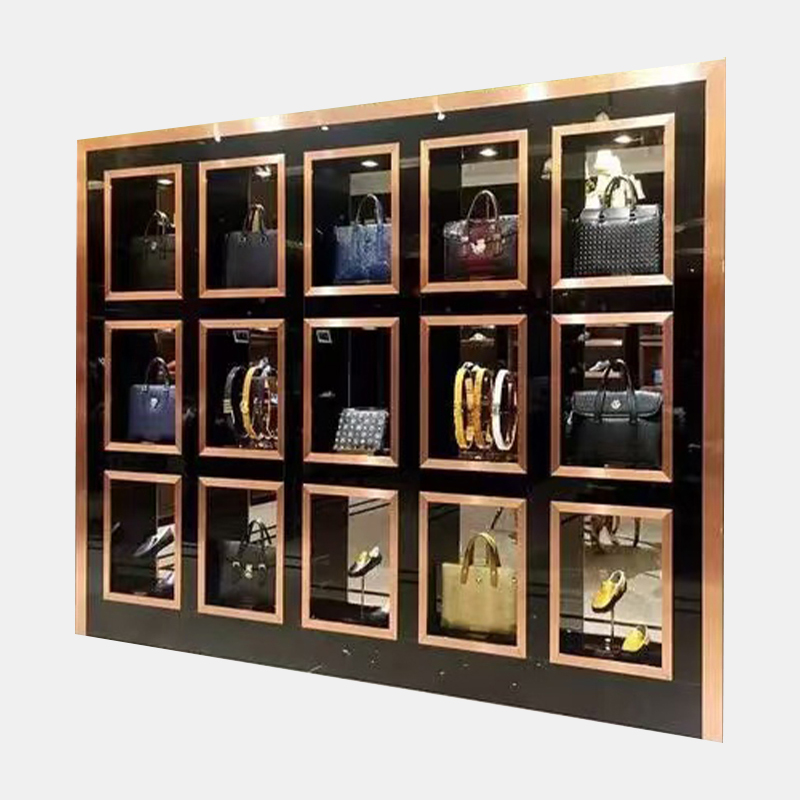 CC-S102 Stainless Steel Clothing Display CabinetStainless Steel Garment Display Cabinet is specially designed for displaying merchandise such as garments and bags. Made of sturdy and durable stainless steel, it is r...View Product →
High glass cabinets take the opposite approach: they prioritise visibility. A tall glazed unit lifts folded product to eye level and lets a whole colour story read from the entrance, which is why window-facing walls usually benefit from glass rather than solid panels.
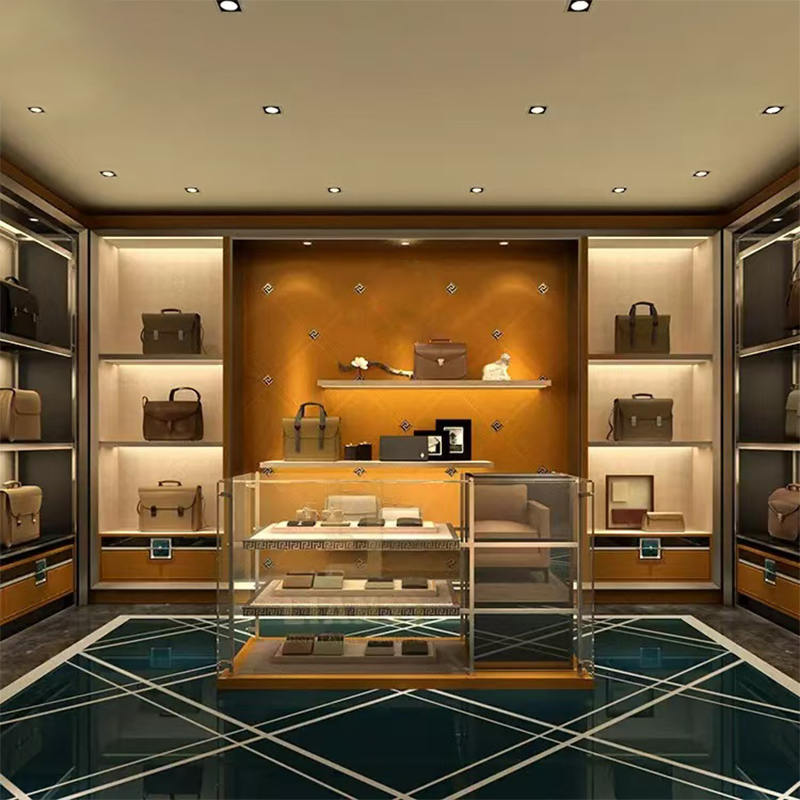 CC-S101 High Glass Clothing Display CabinetThe Glass Tall Cabinet is an elegant and functional showcase designed for displaying clothing and bags. Its fully transparent glass structure ensures that customers ha...View Product →
Combination cabinets sit between the two. They pair steel or lacquered frames with glazed sections, hanging rails and drawers in one footprint, so a single wall run can carry folded basics, hanging items and accessories without three separate purchases.
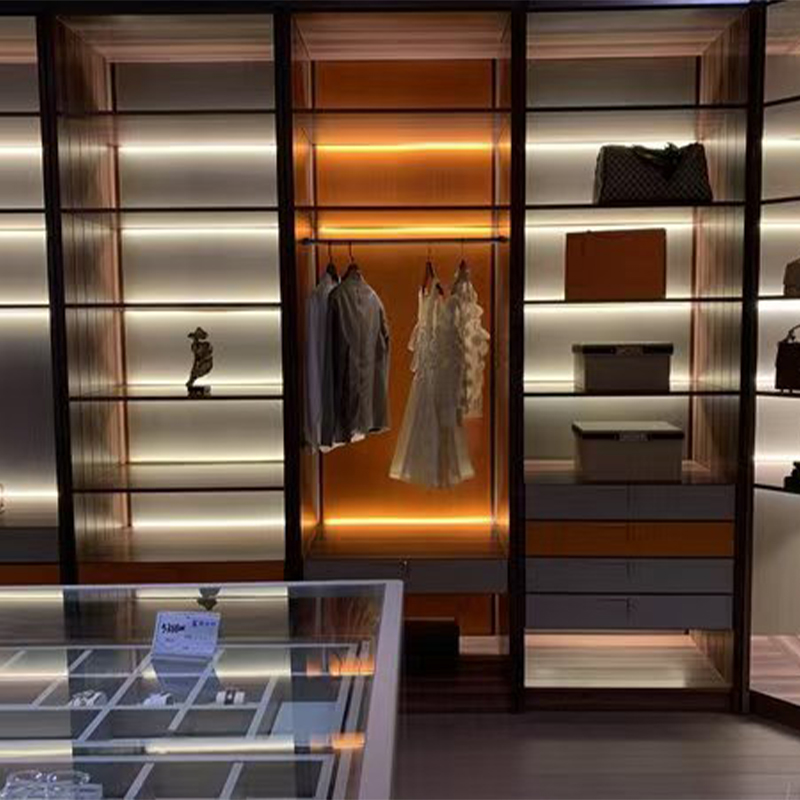 CC-S103 Stainless Steel Garment Combination CabinetThe Stainless Steel Garment Cabinet is a practical piece of furniture made of high-quality stainless steel, which combines beauty and durability, not only effectively ...View Product →
Material trade-offs for clothing display fixtures (relative comparison)
Indicative comparison based on common project specifications, not a laboratory test.
Fabric is a colour surface, and colour is a function of light. Change the light and you change the product. That is why two identical tops can look premium in one store and washed out in the next, even when the fixture hardware is the same.
Clothing cabinets are taller and heavier than they look when loaded, and the failure points are usually the same: an unbraced tall unit, a cable route that was never planned, or a door that cannot open because a neighbouring rail was set 40 mm too close.
Isometric section showing the four elements that carry most clothing displays.
Anyone can send a quotation; fewer suppliers can explain why a rail should sit at 1,600 mm on your floor rather than the 1,400 mm copied from a competitor. That difference is what separates a fixture order from a display project.
Zhejiang Suntop Commercial Display Products Co., Ltd. was founded in 2009. The company's factory covers 25 acres, with a building area of 25,000 square metres and an annual production capacity of 300 projects. Main customer types include jewellery, cosmetics, watches, museums and fashion retail. The company adheres to a highly specialised spirit and strives for excellence in the creation of every display space cabinet, aiming to reflect the customer's brand concept and value through high-quality display environments. After 16 years in the display props industry, Suntop has won provincial high-tech enterprise and credit enterprise awards, and holds more than 30 relevant industry technology patents that support product quality.
For clothing and luggage programmes, the practical advantage of a single supplier covering design, cabinet production and installation management is fewer interfaces. Instead of coordinating a joiner, a glazier and an electrician, the store receives a finished wall. Custom work is handled through a dedicated process, from site measurement to shop drawings, which you can review on our custom display manufacturing page.
Q1. What height should a clothing rail be in a retail store?
Long-hang rails for dresses and coats usually sit 1,500–1,700 mm above the finished floor, and short-hang rails for jackets and shirts 1,000–1,200 mm. Measure your longest garment before the rail position is fixed.
Q2. How deep should a clothing display cabinet be?
Allow 550–600 mm of internal depth for hanging garments, and 350–450 mm for folded goods on shelves. Wider or angled hangers may need an extra 50 mm.
Q3. Is stainless steel or wood better for clothing display cabinets?
Stainless steel with toughened glass lasts longer in high-traffic stores and humid malls. Lacquered wood and MDF give warmer tones and closer brand colour matching, but edges chip more easily.
Q4. How much rail length do I need per garment?
Plan on 5 to 7 cm per hanger, which is roughly 15 to 20 garments per metre of rail. Less than that and browsing slows down noticeably.
Q5. Do clothing display cabinets need internal lighting?
Yes, if the lower rails or folded stacks sit away from ambient light. Use 3,000–4,000 K LEDs with a CRI above 90 and low UV output to protect dye and fibre.
Q6. Can display cabinets be made to fit an irregular wall?
Yes. Curved, angled and shaped cabinets are produced regularly, but the wall should be measured on site first, since plaster and structural columns rarely match the architectural drawing.


 ਪੰਜਾਬੀ
 English
 عربى
عربى русский
 中文简体
中文简体